Our heritage

Tamil roots.
Connected shores.

Generations of life, exchange and hospitality. The story that inspires our gathering.

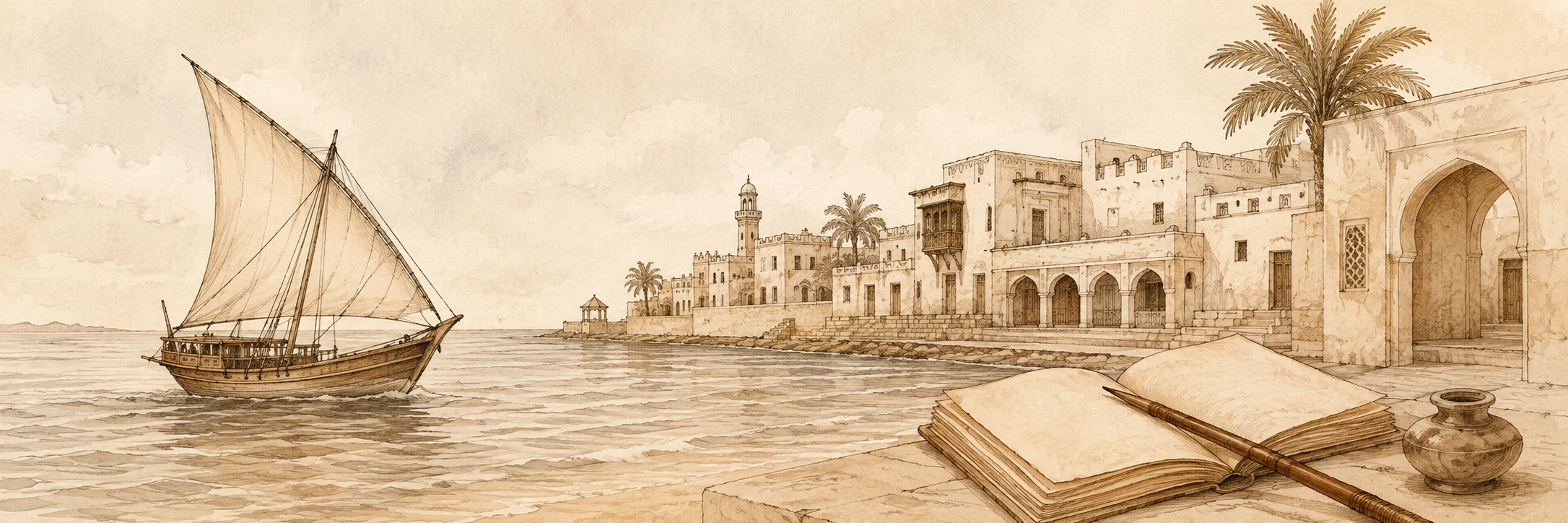
An illustration of an Indian Ocean sailing dhow, coastal architecture and manuscript
01

A coast open to the world

The sea was a meeting place.

To understand Tamil Arab Heritage, begin with the coast. Across the Indian Ocean, Tamil merchants and other South Asian seafarers travelled between ports, carrying goods and building relationships. The sea connected communities to a world beyond their own shore.

These journeys were shaped by the monsoon. Ships sailed with the seasons; merchants worked through networks of trust. Exchange meant more than the movement of objects. It brought people into contact with other languages, customs and ways of living.1, 2

02

Tamil roots. Arab connections.

A heritage lived together.

Connections with Arab traders and Muslim communities became part of the Tamil coast’s wider history. Local lives and overseas relationships met in port towns, households, places of learning and everyday work. Tamil identity continued to shape that experience.

This is the meeting that inspires KKV: Tamil and Arab connections held together with respect. The story has many participants and many generations. It belongs to a connected cultural world, with room for different communities and experiences.3, 4

03

Six places in our heritage

Many towns. A shared horizon.

Kilakarai, Kayalpattinam, Adirampattinam, Nagore, Karaikal and Thondi are the six places recognised in KKV’s heritage story. Together, they keep our attention on a living Tamil coast, beyond any single port or family tradition.

  • Kilakarai
  • Kayalpattinam
  • Adirampattinam
  • Nagore
  • Karaikal
  • Thondi

Kilakarai offers one window into the relationship between commerce and learning. Research on Arwi describes the nineteenth-century figure Imam al-Arus and his work in teaching and print alongside commerce. Scholarship on Kayalpattinam explores another coastal community shaped through maritime connections.3, 4

Each place deserves its own history. At our table, their names are an invitation to discover that wider coast.

04

Language carried connection

Arwi: Tamil in an Arabic script.

Some connections can be heard in conversation; others can be seen on a page. Arwi is Tamil written in an adapted Arabic script, with additional signs for Tamil sounds. It holds Tamil expression within a written tradition connected to Arabic.

Arwi texts include religious learning, literature and practical subjects. They offer a view into the reading, teaching and intellectual life of Tamil Muslim communities. For KKV, this tradition is a meaningful part of the cultural world behind the brand: language, knowledge and identity travelling together.3

05

From coast to kitchen

Heritage lives through people.

Food is one of the most personal ways a heritage is carried forward. It lives in the care of a cook, the preferences of a household, the welcome offered to a guest and the meal prepared for a gathering.

KKV carries forward Tamil Arab Heritage shaped through generations of life, exchange and feast traditions connected to the Tamil coast and Indian Ocean. Our inspiration is that continuing relationship between culture and hospitality, brought thoughtfully into the present.

The signature Kalari Kari Virundhu gives this welcome a place at the centre of the table: rice, curries and accompaniments, offered as a meal to share.

06

A gathering for today

A familiar warmth. A new chapter.

Today, KKV brings its signature Virundhu traditions together with a selected multi-cuisine menu for the family table. Different appetites can find a place here, from a shared feast and mandi to grills, vegetarian favourites and a sweet finish.

Our first outlet is in Tenkasi. As we prepare for our next chapter in Kumbakonam, the promise remains the same: quality in the food, comfort in the space and a warm welcome for the people around your table.

Come with family. Come with friends. Bring your curiosity, or simply your appetite. There is a place for you in the gathering.

Explore the historical sources

These sources inform the regional and literary history. KKV’s present-day hospitality and food are our interpretation of that inspiration.

  1. Matthew Adam Cobb, Indian merchants abroad (2023) — South Asian merchants and Indian Ocean connections.
  2. Eivind Heldaas Seland, Networks and social cohesion in ancient Indian Ocean trade (2013) — journeys, seasons and trading relationships.
  3. Torsten Tschacher, Arwi (Arabic-Tamil): An Introduction (2001) — Arabic-script Tamil, learning and print.
  4. Muslim Trade Networks and Islamisation of the Port Town of Kayalpattanam — maritime connections and a Tamil coastal community.

Make time for a gathering

The table your whole family belongs at.

KKV video

View on Instagram